Skip to content

In industrial power transmission systems, conventional endless V-belts have been the standard drive component for decades due to their simple structural design and high cost-efficiency. However, traditional vulcanized rubber V-belts carry inherent engineering limitations—particularly regarding installation complexity, unscheduled machinery downtime, and rigid maintenance overhead.
To conquer these bottlenecks, the power twist V belt (often generically referred to as a Adjustable link V belt) has stood out as a premier upgrade.
But what exactly is a power twist link belt, and why are facility managers increasingly utilizing it to replace legacy rubber loops? This comprehensive engineering guide explains its internal structure, working principles, core benefits, and how to determine if it is right for your plant machinery.
What Is a Power Twist V Belt?

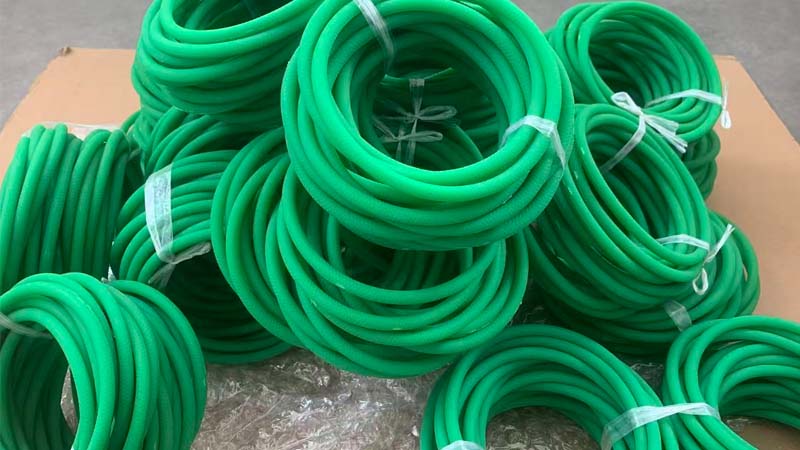
A power twist V belt is a modular, high-performance link-type belt constructed from interconnected individual segments. Instead of relying on a continuous, rigid rubber core, this design utilizes custom-molded composite links mechanically joined together by interlocking tabs.
Historically popularized by Fenner, this genericized “twist-link” architecture allows maintenance crews to:
-
Assemble and adjust the drive loop to any custom length on-site.
-
Perform fast drop-in replacements without dismantling shafts, bearings, or uncoupling heavy electric motors.
-
Isolate and replace individual damaged links rather than scrapping the entire asset.
Because of this unique modular geometry, engineers also commonly search for these components under terms like adjustable V belt, split-link belts, or segmented twist-link belts.
How Does a Power Twist V Belt Work?
Mechanically, a power twist link belt transfers power using the exact same wedge-friction physics as a standard rubber V-belt. When seated inside a standard V-groove pulley, the angled sidewalls of the links wedge into the groove, leveraging friction to transfer rotational torque from the driver shaft to the driven system.
However, the structural distribution of the load is entirely different:
-
Distributed Tension: The mechanical load is distributed across multiple plies of high-strength polyester fabric embedded within a polyurethane composite matrix.
-
Anti-Stretch Matrix: Unlike rubber which naturally suffers from chronic structural stretching over time, premium composite link materials maintain highly consistent tension after initial bedding.
-
Self-Dampening Geometry: The segmented interlocking joints break up harmonic vibrations, ensuring smoother operation even under harsh or misaligned working conditions.
Power Twist V Belt vs. Traditional V-Belt
| Engineering Feature | Traditional Vulcanized Rubber Belt | Premium Power Twist Link Belt |
|---|---|---|
| Length Configuration | Fixed (Must purchase exact sizes) | Fully Adjustable (Build any length on demand) |
| Installation Protocol | Requires extensive shaft/bearing teardown | Installed In-Place (Zero machine disassembly) |
| Unplanned Downtime | High (Hours of lost production) | Minimal (Restored in minutes) |
| Harmonic Vibration | Moderate to High | Significantly Reduced (Absorbed by link joints) |
| Structural Stretching | Common (Requires frequent re-tensioning) | Very Low (After initial natural seating) |
| Inventory Overhead | Must stock dozens of distinct SKUs | One bulk roll fits multiple machines |
| Maintenance Cost | Must replace the entire continuous loop | Replace individual links on-site |
Key Operational Advantages
Easy Installation Without Dismantling
The crowning achievement of the twist-link design is its ability to be threaded into place by hand. For captive shafts, enclosed gearboxes, or complex multi-groove configurations where replacing a traditional belt requires a 4-hour mechanical teardown, an adjustable link V-belt reduces industrial downtime up to 90%, turning a major repair into a 5-minute task.
Adjustable Length and Simplified Inventory
By stocking a single bulk roll of a specific cross-section (such as A or B profiles), your stockroom eliminates the need to calculate and purchase dozens of fixed-length parts. Crews can build any length on demand, and if a system develops slack, you simply pop out a link to restore optimal tension.
Reduced Vibration and Noise
The segmented nature of modular links dampens system harmonics. This drastically reduces operating noise and bearing chatter, making it an exceptional fit for precision machine tools and heavy-duty HVAC blowers.
Outstanding Environmental Resistance
Standard rubber quickly swells and glazes when exposed to harsh chemicals. High-density polyurethane link belts exhibit superior chemical inertness against cutting oils, industrial grease, high humidity, washdown environments, and extreme temperature fluctuations.
Typical Applications

Thanks to their high versatility, these modular drives are widely utilized across global industries:
-
Machine Tools: Precision lathes, milling machines, and surface grinders where vibration dampening is critical.
-
HVAC Systems: Commercial air handling units, industrial exhaust fans, and pumps.
-
Material Handling: Conveyors, packaging lines, and logistics sorting facilities.
-
Heavy Equipment: Agricultural machinery, woodworking equipment, and marine drives.
When Should You Choose a Twist-Link Belt?
Transitioning to a modular alternative is highly recommended if your facility faces any of the following conditions:
-
The financial cost of machine downtime on a specific line is exceptionally high.
-
There is extremely limited physical clearance or space for belt replacement.
-
The drive environment is heavily contaminated with cutting oils, moisture, or mild solvents.
-
It is difficult or impossible to measure the exact internal center-distance length of an old belt.
Are Power Twist V Belts as Strong as Traditional V-Belts?
A frequent concern among procurement managers is whether a segmented belt can match the raw strength of a solid rubber core.
Modern composite link belts are reinforced with advanced multi-layer polyester fabric. In almost all light-to-medium and standard heavy-duty industrial applications, their power ratings and torque transfer capabilities are fully comparable to commodity rubber belts. However, before executing a full retrofit on systems suffering from violent shock loads or extreme high-speed RPMs, it is always wise to review if a link V belt is worth it by analyzing your specific drive parameters.
Common Belt Profiles Available
To ensure seamless drop-in compatibility, these modular belts are manufactured to precisely match standard classical rubber V-belt profiles:
-
Standard Profiles: Z/10, A/13, B/17, C/22, and D/32 cross-sections.
-
Metric Equivalents: SPZ, SPA, SPB, and SPC configurations.
This dimensional alignment guarantees that you can upgrade your drive performance immediately using your existing standard pulleys—zero machining or re-grooving required.
Summary: Is a Power Twist Alternative Right for You?
Ultimately, incorporating modular twist-link belting into your facility is a long-term maintenance optimization strategy. It transforms how your factory manages spare parts, cuts down unplanned stop-time, and enhances overall machine reliability.
As a premium industrial manufacturer, Puteken specializes in high-durability, oil-resistant industrial link belt designed to match and exceed international standards.
Whether you need a bulk wholesale quote for factory retrofits or require custom technical profile cross-sections, our global application engineers are ready to assist. Contact Puteken Engineering Today to request your custom engineering samples and pricing structures.