Skip to content

In the power transmission industry, selecting the optimal drive component dictates not only mechanical efficiency but also long-term factory operational costs. Among friction-driven systems, standard heavy-duty endless V-belts and modular link belts represent two distinct design philosophies for handling torque transfer between pulleys.
The core variance lies in mechanical adaptability versus single-piece continuous structure. While traditional wrapped or raw-edge V-belts rely on a fixed, pre-manufactured continuous loop, modular link variations utilize interconnected multi-unit segments to achieve identical cross-sectional drive geometries. Understanding these foundational differences allows mechanical engineers and plant procurement managers to properly spec drives based on lifecycle ROI, environmental hazards, and downtime constraints rather than initial purchase price alone.
Structural Comparison: Modular Links vs. Endless Rubber
Examining the cross-sectional architecture highlights the distinct material stresses both belt styles endure under load:
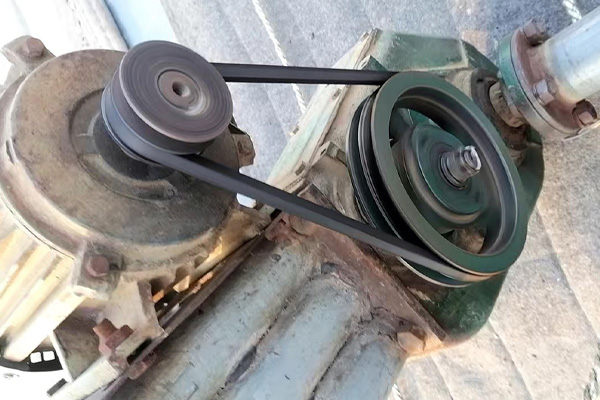
- Traditional Endless V-Belts: Constructed as a monolithic, continuous ring. The inner core typically features pre-tensioned load-bearing polyester or aramid (Kevlar) tensile cords embedded in a synthetic rubber matrix (such as EPDM or Neoprene), wrapped in a protective woven fabric jacket. The structural length is rigid and immutable post-manufacture.
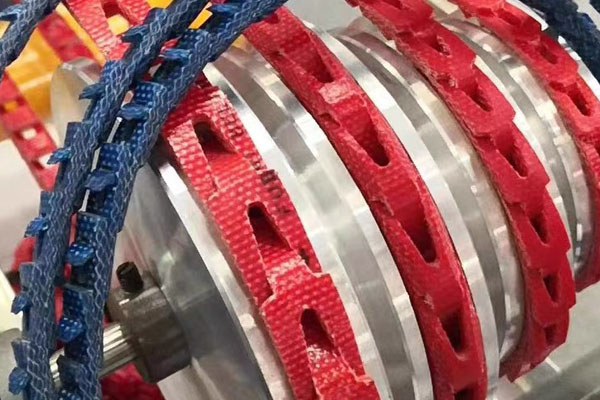
- Link Belts: Composed of custom-molded composite links made of high-strength polyurethane reinforced with multiple layers of woven polyester fabric. These individual elements are interconnected via metal rivets or interlocking twist-lock designs. This segmented architecture allows technicians to alter the physical length of the belt manually on-site by simply twisting, adding or extracting individual modules without changing the pulley system layout.
Performance & Durability: Power Transmission vs. Environmental Resistance
When evaluating raw power density versus continuous structural integrity in hostile operating environments, both designs exhibit clear tradeoffs:
-
Power Transmission & Efficiency: For ultra-high-speed setups and heavy-duty shock loads, standard V-belts retain a slight advantage in continuous torque transmission. Their unbroken tensile cords run linearly without joints, offering high dimensional stability and minimal structural stretch under consistent high-tension industrial drives.
-
Environmental Degradation & Wear: Traditional rubber compounds are highly susceptible to chemical rot, drying, cracking, and structural slippage when exposed to ambient industrial oils, cutting fluids, grease, and extreme temperature fluctuations. Conversely, the advanced polyurethane construction found in premium modular link designs offers superior chemical isolation. Polyurethane naturally repels volatile organic compounds, industrial lubricants, water, and abrasive particulate dust, preserving structural coefficient of friction where standard rubber belts rapidly glaze, delaminate, and fail.
Installation & Maintenance: Minimizing Downtime in Industrial Drives
Labor overhead and machine downtime often surpass hardware replacement costs. The primary operational bottleneck of a standard continuous V-belt occurs during installation on captive or inboard shafts (e.g., center-mounted industrial blowers, complex conveyor head-shafts, or heavy lathe spindles). Replacing a blown endless belt frequently forces maintenance teams to dismantle external bearings, remove overhead couplings, or pull out massive drive shafts—a process that easily consumes hours of unscheduled factory downtime.
Modular link structures bypass this mechanical teardown entirely. Because the belt can be opened and re-linked at any point along its path, a technician can easily thread the unlinked segment directly through confined machine frameworks and around pulleys before securing the final joint link. Tensioning adjustments require no base plate movement; if a belt slacks over long operational cycles, a technician can simply pop out a single link on-site to restore precise operational tension within minutes, significantly maximizing workshop productivity.
Cost-Benefit Analysis: Upfront Cost vs. Long-Term ROI
A short-sighted procurement process focuses solely on unit purchase price, whereas proper asset management tracks Total Cost of Ownership (TCO):
-
Initial Acquisition Capital: Conventional rubber V-belts have an undeniably lower upfront unit cost. Commodity manufacturing of standard rubber loops makes them highly economical for initial machine builds or simple replacement budgets. Modular links carry a higher initial purchase premium due to the complex multi-layered polyurethane composite molding process.
-
Operational Lifecycle ROI: The premium paid for modular setups is rapidly recouped across three major avenues:
-
Reduced Inventory Overhead: Instead of stocking dozens of specific endless belt lengths to cover various machines, a factory only needs to stock a single box of major cross-sections (e.g., A/4L, B/5L, C) to build custom lengths on demand.
-
Labor Cost Savings: Elimination of complex machine tear-downs drops average maintenance times from hours to minutes.
-
Extended Service Life: Superior resistance to oils and friction-induced heat minimizes wear cycles, ensuring fewer yearly replacement interventions.
-
Vibration & Noise Control: Elimination of Belt Memory
One of the least understood failure points in precision machining and ventilation systems is “belt memory.” When a standard continuous rubber belt sits idle on a stationary pulley for extended periods, or stays coiled tightly inside a warehouse storage bin, it develops fixed deformation bends—commonly called structural memory. Upon restarting the drive, these stiff deformations create cyclical harmonic vibrations as they pass around the pulleys, resulting in high mechanical noise, bearing chatter, and visible surface finish flaws on precision CNC or lathe operations.
Segmented link belts inherently lack structural memory. Because the belt is comprised of independent pivoting links, it conforms immediately to the true radius of the pulley groove without retaining flat spots or storage bends. This articulating motion breaks up harmonic frequencies, dampens operational chatter, and ensures a smoother, quieter transfer of kinetic energy even on older, slightly misaligned pulley configurations.
Selection Guide: When to Choose a Link Belt over a V-Belt
Rather than navigating ambiguous specifications, use this operational blueprint to determine the precise fit for your factory infrastructure:
-
Deploy Traditional Endless V-Belts When: The application involves highly stable continuous loads exceeding 100 horsepower, operates at exceptionally high RPMs without chemical exposure, possesses easily accessible open pulleys with adjustable motor bases, and demands the lowest possible upfront component costs.
-
Upgrade to Modular Belts When: The belt must be routed through captive shafts or confined spaces where machine disassembly is cost-prohibitive; the operating environment contains airborne oils, cutting fluids, or abrasive dust; the machine experiences frequent start-stop cycles or prolonged idle periods prone to belt memory; or you intend to slash facility spare-part inventory by standardizing on bulk-adjustable rolls.
Summary Table: Link Belt vs. V-Belt Feature Comparison
| Feature | Modular Link Belt | Traditional V-Belt |
|---|---|---|
| Structure | Modular links assembled into a belt | Endless rubber belt |
| Length Adjustment | Easily adjustable on site by adding or removing links | Fixed length, no adjustment |
| Installation | No need to dismantle pulleys or shafts | Often requires pulley removal |
| Maintenance | Individual links can be replaced | Entire belt must be replaced |
| Downtime | Minimal – fast installation and repair | Longer downtime |
| Vibration Reduction | Excellent vibration and noise reduction | Moderate, may develop belt “memory” |
| Load Capacity | Suitable for light to medium loads | Excellent for medium to heavy loads |
| Power Transmission Efficiency | Slightly lower than V-belt | Higher efficiency |
| Resistance to Oil & Chemicals | Very good (polyurethane material) | Limited (rubber degradation possible) |
| Operating Environment | Ideal for dirty, oily, or humid environments | Best for clean, stable environments |
| Service Life Cost | Lower long-term maintenance cost | Lower initial cost, higher replacement cost |
| Typical Applications | Maintenance-heavy equipment, retrofits | High-speed, high-power drives |
Need a Custom Drive Solution? How Puteken Can Help
Resolving complex power transmission inefficiencies requires more than off-the-shelf components—it demands application-specific engineering expertise. As an established manufacturer of high-tier industrial belting solutions, Puteken specializes in supplying high-performance, polyester-reinforced polyurethane custom link belt series alongside high-density power transmission drives optimized for harsh industrial realities.
By controlling advanced composite formulations, we ensure our modular solutions deliver optimal tension retention, structural durability, and seamless integration into your existing pulley profiles. Whether you are seeking to eliminate chronic maintenance bottlenecks on your glass tempering lines, upgrade intensive packaging conveyor drives, or optimize your facility’s internal spare parts pipeline, Puteken delivers the technical precision your bottom line requires.
Contact our application engineering team today to review your system specifications and secure a tailored quote.
FAQ
1.Can a link belt fully replace a traditional V-belt?
In most maintenance and retrofit applications, yes. For extremely high-power transmission, traditional V-belts may still be preferred.
2.Do link-style belts suffer from accelerated rotational slip?
No. Because they are constructed from high-coefficient polyurethane rather than commodity rubber, they grip standard iron or aluminum pulley walls securely. As long as the initial link count matches the designated pitch length, they maintain stable, non-slip power transmission without premature elongation.
3.In which specific machine configurations do modular belts offer the highest operational return?
They offer maximum return on captive-shaft machinery where changing a standard loop forces bearing removal, such as rooftop air handlers, manufacturing conveyor turns, glass handling furnaces, laser cutting machine lathe and marine auxiliary line drives. They are also ideal for harsh processing environments heavily exposed to oil mist and chemical splash.